The Ultimate Guide to Construction Site Documentation (2026)
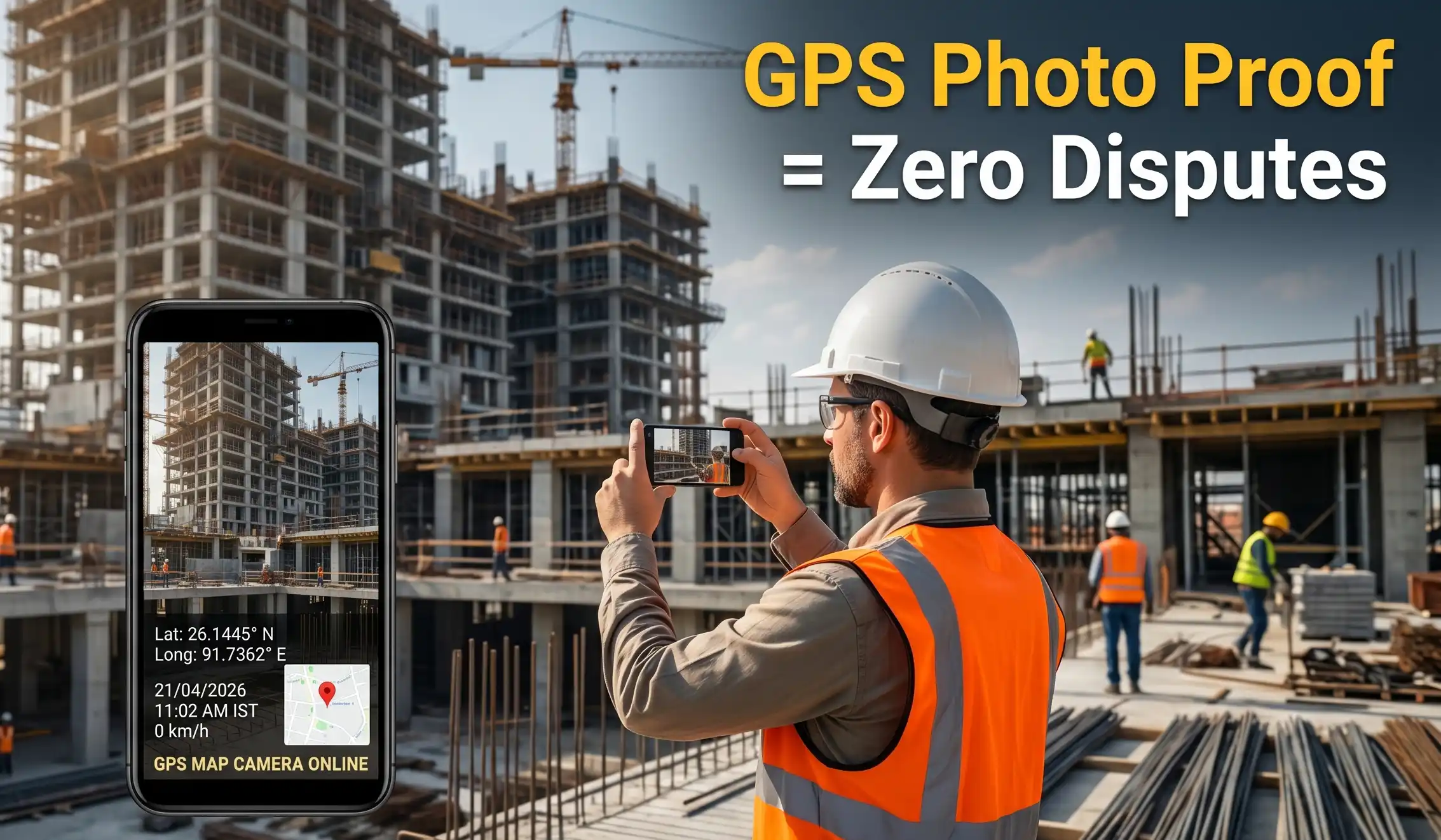
In the construction industry, information is the most valuable currency. A project can have the best architects and the most skilled labor, but without an airtight documentation strategy, it is vulnerable to lawsuits, payment delays, and regulatory fines. In 2026, "He Said, She Said" is no longer a defense. You need objective, satellite-verified visual proof.
Using a GPS Map Camera Online utility has transformed from a "handy tool" into a mandatory compliance requirement for modern engineering firms. This guide provides a technical roadmap for implementing visual GPS documentation across your projects to ensure safety, accountability, and rapid milestone approvals.
Guide Contents
The True Cost of Poor Documentation
Industry statistics show that over 30% of construction projects involve a significant legal or financial dispute. Most of these disputes center around "as-built" conditions—did the contractor actually install the proper reinforcement bars before the concrete pour? Was the site appropriately secured and safe at 5:00 PM on a Friday before a storm hit?
Traditional photography fails in these scenarios because it lacks Immutable Context. A standard photo without a visual GPS stamp can be easily challenged in arbitration as being taken at a different site or a different time. By choosing to add GPS location to photos online, you are essentially notarizing your digital media. You lock in the exact coordinates, timestamp, and visual state of the project, removing all ambiguity.
Standard Workflow for Geotagged Photos
To pass an external audit or a government inspection smoothly, your documentation must follow a consistent technical standard. Ad-hoc photos taken by different subcontractors on personal phones lead to fragmented data. Here is the recommended workflow used by top-tier engineering firms:
Standard Operating Procedure (SOP)
- Pre-Capture: Ensure the device has a clear satellite lock. Do not capture vital proof photos deep indoors where GPS signals drift.
- Verification: The photographer must verify that the "Project Name" and "Site Phase" are manually updated in the stamp fields to provide instant context.
- The Inset Rule: Every critical documentation shot must include the map inset. This shows the orientation of the photographer relative to the structure, which is vital for large, multi-acre sites.
Reducing Liability and Insurance Premiums
Insurance companies in 2026 are increasingly offering lower premiums to firms that utilize "Verified Visual Reporting." When you use GPS photos for legal proof, you provide the underwriter with a high-fidelity record that massively reduces their risk profile.
In the event of a worker injury, material theft, or structural failure, having a daily library of time-stamped, geotagged photos allows for a rapid investigation. Often, this objective proof exonerates the firm from false claims, saving millions in potential litigation costs.
Speeding Up Milestone Payments
One of the biggest bottlenecks in commercial construction is the "Approval Delay." Clients and financiers often hesitate to release escrow payments until they can physically verify work completion. For remote stakeholders, this means waiting days or weeks for an in-person site visit.
By sending a daily or weekly report filled with GPS-stamped photos, you provide Virtual Verification. A photo showing the site progress with an undeniable location stamp and timestamp acts as an immediate milestone trigger. Firms adopting this practice frequently report reducing payment cycles from 30+ days down to less than 7 days.
The 7-Point Daily Site Checklist
To ensure nothing is missed, site managers should implement this daily visual documentation checklist:
- Site Arrival: Capture a wide-angle shot of the entrance with a GPS stamp to log the official start time and site state.
- Safety Briefing: Document the safety board and crew to prove compliance with OSHA or local safety standards.
- Material Receipt: Stamp photos of delivered materials to verify quantity, quality, and time of delivery against the manifest.
- Hidden Work: Always stamp photos of utilities, rebar, wiring, or plumbing just before they are covered by walls, drywall, or flooring.
- Milestone Completion: The final shot of a completed phase must include high-accuracy coordinates and a map overlay.
- Weather Documentation: If work is delayed due to severe weather, document the site conditions with a timestamped stamp for "Force Majeure" contract claims.
- Site Departure: A final secure-site photo showing all equipment locked, fencing secured, and the site safe for the night.
Metadata vs. Visual Stamps: An Audit View
Why not just rely on the hidden EXIF data saved by your phone? Because metadata is fragile.
| Metric | Standard Metadata (EXIF) | Visual GPS Stamps |
|---|---|---|
| Auditor Ease | Requires technical software to view | Instant recognition by anyone |
| Tamper Proof | Easily edited with free apps | Requires pixel-level manipulation |
| Sharing | Stripped by WhatsApp & Socials | Remains a permanent part of the image |
| Report Quality | Hidden from stakeholders | Highly professional & verifiable |
As we analyzed in our guide on adding location without EXIF, auditors and legal teams overwhelmingly prefer visual stamps because they eliminate the need for forensic file analysis during a quick review. What you see is what you get.
The Bottom Line
In 2026, site documentation is no longer just about taking pictures—it’s about data integrity. By moving away from "heavy" apps that track your personal data and utilizing a privacy-first online GPS Map Camera, your firm stays compliant, secure, and efficient.
Construction FAQ
Standardize your site documentation today
Generate professional, verifiable GPS-stamped photos in seconds. No app, no fees, just proof.
Start Stamping Reports
Priyanshu built GPS Map Camera Online after running into privacy issues and slow performance with traditional mobile GPS camera apps. He specialises in browser-based tools for field documentation and photo geotagging — keeping everything fast, private, and free.
View all posts →